Free Python and Node.js Hosting in 2026: Which Free Tiers Still Exist, and What Sleeps
Free Python web hosting still exists in 2026, but every option now comes with a short leash. PythonAnywhere's free plan runs one Python web app on its own subdomain with 100 CPU-seconds a day. Render's free web services run Python or Node but go to sleep after 15 minutes without traffic. For Node.js, Cloudflare Workers, Vercel Hobby and Netlify's free plan run functions rather than always-on servers, each with its own cap, and Vercel's free plan bans commercial use.
That makes free tiers right for learning, demos, portfolios and hobby APIs. They are wrong for a bot that must stay online, a client project or anything earning money, where a $4 to $6 virtual server is the honest answer. Many pages ranking for this topic still recommend Heroku's free dynos, which ended in November 2022. Everything here was read on the providers' own pages on 9 Oct 2026 unless we say otherwise.
Which free Python and Node hosts still exist
Five free tiers are worth knowing, and they split into two kinds. PythonAnywhere and Render run your app as a real long-lived process, the way it runs on your laptop. Vercel, Netlify and Cloudflare Workers run your code as functions that start per request and stop when the response is sent. Flask and Django apps fit the first kind naturally. APIs, webhooks and server-rendered Node front ends fit the second.
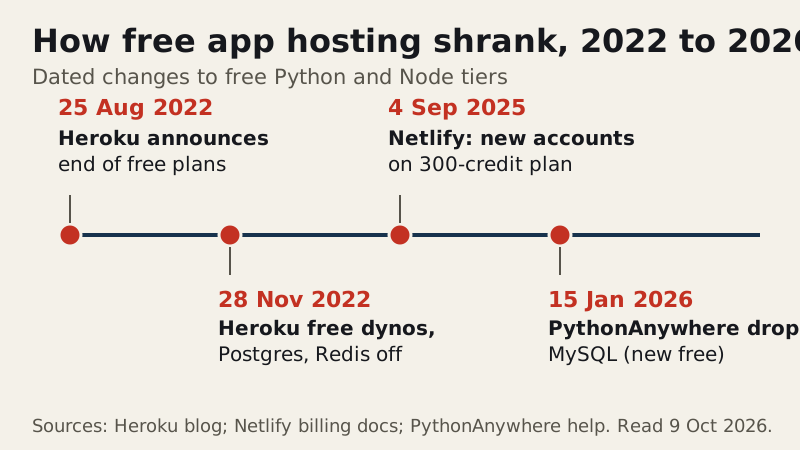
What no longer exists is the free always-on server. Heroku switched off free dynos, free Heroku Postgres and free Heroku Data for Redis on 28 Nov 2022, after announcing the change on 25 Aug 2022. Every free tier that survived did so by limiting time, CPU or use.
Free-tier limits side by side
The table puts each free tier's catch in one row. "Idle behaviour" is the column that surprises people most: a sleeping app takes time to wake up, and the first visitor pays for it.
| Provider | Runs | Idle behaviour | Free allowance | Catch | First paid step |
|---|---|---|---|---|---|
| PythonAnywhere Beginner | 1 Python web app | One-month expiry on free web apps | 100 CPU-seconds/day, 512 MB disk | No custom domain; outbound web allowlist | Developer, $10/month |
| Render Free | Python, Node and other web services | Sleeps after 15 min; about 1 min to wake | 750 instance hours per workspace/month | 512 MB RAM, 0.1 CPU; files lost on sleep | $7/month, 512 MB RAM |
| Vercel Hobby | Serverless functions | Per request | 1M invocations, 4 h Active CPU, 100 GB transfer | Non-commercial use only | Pro, $20/month |
| Netlify Free | Serverless functions | Per request | 300 credits/month; compute 10 credits per GB-hour | All projects paused at the limit | Personal, $9/month (1,000 credits) |
| Cloudflare Workers Free | JavaScript functions | Per request | 100,000 requests/day, 10 ms CPU each | Tight CPU per request | Workers Paid, $5/month minimum |
PythonAnywhere's free plan explained
PythonAnywhere is the simplest place to put a Flask or Django app online for free. The Beginner plan gives you one web app at your-username.pythonanywhere.com, up to two consoles, 512 MB of storage and 100 CPU-seconds a day. You cannot attach your own domain on the free plan.
Three restrictions trip people up. Outbound internet access from free accounts is limited to an allowlist of sites over HTTP or HTTPS, so a script that calls an API outside that list will fail. Accounts created from 15 Jan 2026 (8 Jan on the EU system) no longer get MySQL or the daily scheduled task; older free accounts keep them. And the help page gives free web apps a one-month expiry, so a free app is not a set-and-forget deployment.
The first paid plan, Developer, is $10 a month billed monthly. It adds a custom domain, 5,000 CPU-seconds a day and 5 GB of disk, with a 30-day money-back guarantee.
Render's free web services: the sleep rule
Render lets you deploy a Python or Node web service from a Git repository on a free instance with 512 MB of RAM and 0.1 CPU. The trade is sleep: a free service spins down after 15 minutes without inbound traffic and takes about a minute to spin up again, and anything written to the local filesystem is lost when it sleeps, restarts or redeploys. Custom domains work on free services.
The monthly pool is 750 free instance hours per workspace, and when it runs out every free service in that workspace is suspended until the next calendar month. The arithmetic matters: one service awake around the clock uses 744 hours in a 31-day month, just inside the pool, so a second always-awake service would exhaust it. Free Postgres on Render is 1 GB and expires 30 days after creation, with 14 days' grace to upgrade before deletion, so it is for testing only. The smallest paid instance is $7 a month for 512 MB of RAM.
Vercel, Netlify and Cloudflare Workers for Node
These three run Node code as functions, which suits APIs, form handlers and server-rendered front ends. None of them keeps a process running between requests, so WebSocket servers, queues and bots need something else.
Vercel's Hobby plan includes 1 million function invocations, 4 hours of Active CPU and 100 GB of fast data transfer a month. Its fair-use rules limit Hobby to non-commercial personal use, and the definition of commercial is wide, covering advertising of any kind, sales, work you are paid for and affiliate-led sites. Anything that earns money needs Vercel's Pro plan, $20 a month including $20 of usage credit (read 10 Oct 2026).
Netlify's free plan, for accounts created from 4 Sep 2025, works on 300 credits a month. Function compute costs 10 credits per GB-hour, bandwidth 20 credits per GB and every production deploy 15 credits, so frequent deploys eat into the same pool your functions use. At the limit Netlify pauses all your projects until the credits reset, which spares you a bill but takes the site down. The next step up, Personal, is $9 a month for 1,000 credits.
Cloudflare Workers' free plan allows 100,000 requests a day with 10 milliseconds of CPU time per invocation, according to Cloudflare's pricing docs read on 10 Oct 2026. That is generous on volume and strict on work per request: fine for routing, redirects and light JSON APIs, too tight for heavy processing. Workers Paid has a $5 monthly minimum per account.
When a $4 to $6 VPS beats any free tier
A small virtual server costs less than a lunch and removes every limit above: no sleep, no CPU-seconds, no allowlist, any domain, any port and any language. You do take on the work of patching the operating system, setting up a firewall and running your app under a process manager, so it is a step up in responsibility as well as reliability.
On price, DigitalOcean's Basic Droplets start at $4 a month for 512 MiB of RAM, 1 vCPU and 10 GiB of SSD, or $6 for 1 GiB and 25 GiB, now billed per second. Vultr's Cloud Compute Regular plan with 1 GB of RAM, 1 vCPU and 25 GB is $5 a month; its smaller 512 MB plans are sold in only one or two locations. Hetzner's CX23 in Germany or Finland is €5.49 a month before VAT and a €0.50 IPv4 charge, though its cost-optimised plans showed as currently unavailable when we checked. None of these three is a partner of this site; they are here because they are the honest reference prices.
Hostinger VPS
Hostinger's KVM 1 VPS (1 vCPU, 4 GB of RAM, 50 GB of NVMe storage and 4 TB of bandwidth) is advertised at $6.49 a month, paid upfront, and its pricing page says it renews at $11.99 a month for 2 years (read 10 Oct 2026). That costs more than the bare reference servers above, but it brings four times the RAM of DigitalOcean's $6 Droplet, free weekly backups and snapshots, and one-click installs of common Linux stacks. It is the one server on this page we earn from: Hostinger's KVM plans suit you if more memory, built-in backups and one-click setups are worth the higher renewal.
Affiliate link — a paid host we recommend once you have outgrown free. We may earn a commission at no cost to you. Check the renewal price, not just the intro price, before you buy. Every free host on this site pays us nothing.
Edge cases and traps
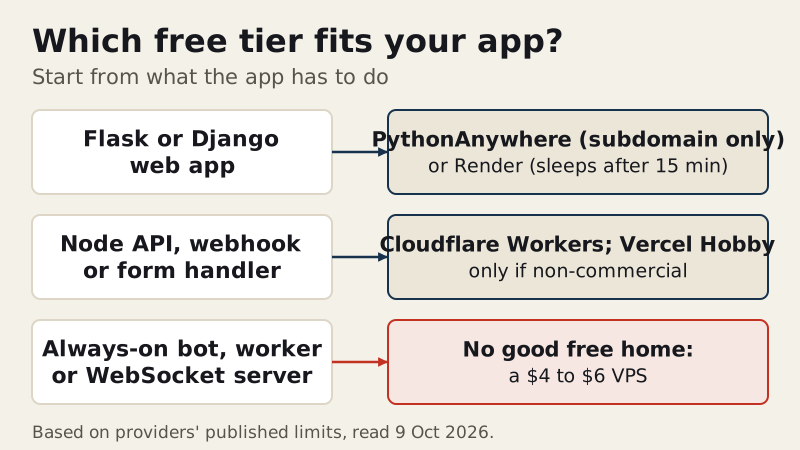
A few situations break the neat categories. Telegram and Discord bots need an always-running process, so function platforms don't fit and Render's free tier sleeps; a VPS is the realistic home. Scheduled scripts are the second trap: PythonAnywhere's daily task is gone for new free accounts and Render's free services sleep, so cron-style jobs need a paid plan or a VPS. Third, free databases are short-lived: Render's free Postgres expires after 30 days, and a function platform has no database of its own.
Finally, watch the use rules as closely as the limits. A portfolio on Vercel Hobby is fine; the same site with an affiliate link or AdSense breaks the terms. If you are learning, any of these tiers will do. Our free hosting limits guide explains how caps like these are enforced on other kinds of free hosting too.
Free Python and Node hosting: questions on the record
Is there free Python web hosting in 2026?
Is PythonAnywhere free forever?
Where can I host a Node.js app for free?
Does Heroku still have a free tier?
Why does my free Render app take a minute to load?
Start from the top of the file: the best free web hosting, honestly ranked, or read whether free web hosting is safe before you build.